Antigua and Barbuda Brings Agricultural Experience to Regional Knowledge Exchange in Canary Islands by Camellia Wallace Tonge
Antigua and Barbuda’s agricultural experience is contributing to a wider exchange of knowledge and practical approaches to strengthening island food systems, as Director of Agriculture Gregory E. Bailey represents the country at an Organization of Eastern Caribbean States (OECS) study visit to the Canary Islands from November 8–14, 2026.
Held under the theme “Resilience of Island Food Systems: From Local Production to Healthy and Sustainable Diets,” the visit brings together representatives from OECS Member States for technical exchanges, institutional engagements and field visits across Lanzarote and Gran Canaria. The programme is undertaken through the EUCaN – Nourishing Futures Together project, implemented by FIAP and funded by the European Union. Its areas of focus include local food production, agro ecology, water management, school feeding, public procurement, healthy diets and coordination across sectors.
An important aspect of the engagement is the recognition that knowledge sharing is not a one-way process. Antigua and Barbuda brings established agricultural experience to the discussions, particularly in water management and crop propagation. The country has been utilizing rooftop and runoff rainwater harvesting, alongside drip irrigation, since the early 1980s. These practices demonstrate longstanding national experience in water conservation and efficient irrigation. The country also brings practical expertise in plant propagation, particularly in the efficient utilization of root-crop planting material, offering another area for technical exchange between the territories.
The Canary Islands, in turn, offer valuable experience in traditional agricultural systems closely connected to cultural heritage and agro tourism, particularly in Lanzarote, where farmer cooperatives, wine guilds and local associations contribute to sustaining agricultural practices. The programme also includes a visit to the Melenara Fishers’ Cooperative in Gran Canaria, providing an opportunity to examine cooperative organization within the fisheries sector. The Canary Islands’ wider agricultural research network offers further technical perspectives: the Canary Islands Institute of Agricultural Research (ICIA) provides soil, water and leaf analysis, while the Canary Islands Institute of Technology (ITC) undertakes pesticide-residue monitoring and environmental analysis. These different areas of experience highlight opportunities for complementarity and mutual learning.
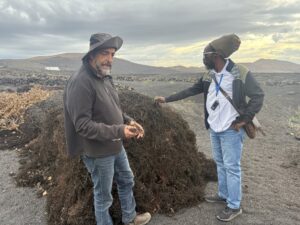
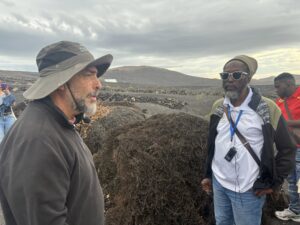
The visit’s programme reflects the breadth of these engagements. In Lanzarote, participants are examining traditional agricultural systems recognized under the island’s Globally Important Agricultural Heritage System (GIAHS), including the use of volcanic material known as picón (volcanic ash) in traditional vine cultivation at La Geria. These methods demonstrate how agricultural practices have evolved to conserve moisture and support production under arid conditions. The programme also includes a presentation on a traditional wind-powered desalination plant for agricultural use. In Gran Canaria, engagements extend to inter-island cooperation, agricultural extension and research, including visits to the Arucas Experimental Farm and a technical presentation on the IDIWATER project, which explores innovative water management and desalination technologies for agricultural use.
Further engagements address food education, healthy diets, pesticide monitoring, territorial governance and sustainable rural development. Participants are also examining the Canary Islands Ecocomedores (eco-canteens or organic dining hall) Programme, which connects local agricultural production with school meals, through a programme presentation and visits to a public nursery and primary school and an agro ecological farm.
For Antigua and Barbuda, the value of the engagement extends beyond observing agricultural practices in another island territory. It provides an opportunity to share national experience, examine approaches developed elsewhere and identify areas where collaboration and technical knowledge exchange can contribute to agricultural development. Through this engagement, Antigua and Barbuda is both contributing to and benefiting from regional and international agricultural cooperation, reinforcing the importance of shared knowledge in building more resilient island food systems from production to consumption.