Ministry Advances Agricultural Pond Rehabilitation to Strengthen Water Security for Farmers by Camellia Wallace Tonge
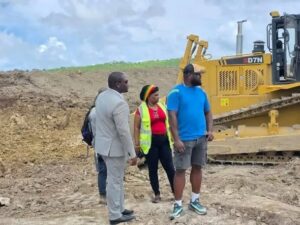 The Ministry of Agriculture, Lands, Fisheries and the Blue Economy is continuing the works to improve water storage infrastructure across Antigua, with the rehabilitation of existing ponds and the development of additional water catchment facilities forming part of a wider effort to address water challenges facing the farming community. Reliable access to water remains an important requirement for agricultural production, particularly during extended dry periods when farmers depend on stored supplies to maintain their crops and sustain their operations.
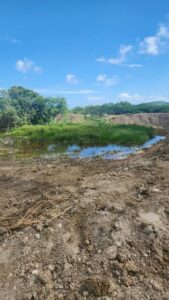
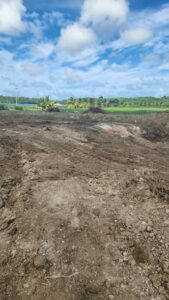
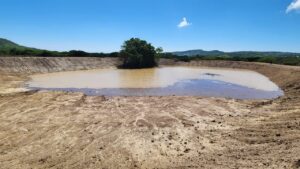
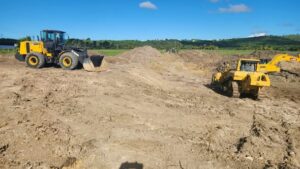
At the Wally Browne farm located in Bethesda, rehabilitation work on an agricultural pond has addressed a leakage problem while improving the existing structure. The pond, which has an estimated storage capacity of approximately one million gallons, required attention to its slipway after water loss was identified. During the works, heavy-duty equipment operators excavated the affected area, exposing a natural deposit of clay beneath the surface. The material was subsequently used to seal the leaking section, providing a practical solution using resources available on site. Further improvements included reshaping the pond and installing concrete slabs at the slipway to reinforce the structure and provide additional support. The rehabilitation took approximately two months to complete.
The Bethesda project forms part of the Ministry’s wider efforts to improve agricultural water infrastructure under the leadership of the Honorable Anthony Smith Jr., Minister of Agriculture, Lands, Fisheries and the Blue Economy. In June 2026, Minister Smith informed Cabinet that the Government had secured approximately US$9 million through the Caribbean Development Bank (CDB) and the Food and Agriculture Organization (FAO) Soil and Water Management Programme. The funding is intended to support the construction of dams, water catchment and other soil and water conservation infrastructure. Cabinet was also informed that locations had been identified for eight dams and two larger-scale storage facilities across Antigua, as part of plans to expand the country’s agricultural water storage capacity.
The importance of these initiatives is further underscored by the current climate outlook. The Caribbean Institute for Meteorology and Hydrology (CIMH), in its November 2026 to January 2027 outlook, has highlighted the potential for drought conditions to expand or intensify across the region amid the ongoing El Niño events. The outlook also points to unusually low shower and wet-spell frequency, as well as the likelihood of unseasonably high temperatures during the cool season, although fewer episodes of excessive heat are expected. Such conditions could place additional pressure on agricultural water supplies, making the ability to capture and retain rainfall particularly important for farmers.
To support the implementation of these projects, the Ministry acquired a dedicated excavator in August 2025 to assist with dam construction and the development of water-catchment systems. The additional equipment is expected to strengthen the Ministry’s capacity to undertake infrastructure works and expand water-storage facilities across farming districts.
Access to dependable water supplies remains essential to maintaining agricultural production, particularly during prolonged dry periods. By improving existing facilities and expanding the country’s capacity to capture and retain rainfall, the Ministry is working to address one of the longstanding challenges facing local farmers and create better conditions for sustained domestic food production. This project is supervised by Miss Charlene Scott/Supervisor for the heavy-duty machinery with the Ministry.