Contour Farming
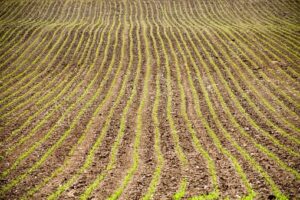 Contour farming is a simple yet powerful agricultural method used to grow crops on sloped land. Instead of plowing and planting in straight lines up and down a hill, farmers plow across the slope, following the natural curves and elevation lines of the landscape.
When farmers plant rows straight down a hillside, those rows turn into “water highways” during heavy rain. Rainwater races down these paths, picking up speed and washing away nutrient-rich topsoil. Contour farming acts like a natural brake system for that water.
How Contour Farming Works
A “contour line” is an imaginary line across a slope where every point is at the exact same height above sea level. To use this method, farmers map these lines across their hillsides using simple tools like a wooden A-frame level or modern GPS equipment.
Once the lines are marked, all plowing, planting, and harvesting follow these exact curves. This creates a pattern of parallel ridges and shallow grooves (furrows) curving around the hill. When it rains, each curved row acts like a miniature dam. Instead of rushing straight downhill, the water hits these ridges and slows down.
The Key Benefits
● Cuts Soil Erosion in Half: Because the water is forced to slow down, it loses its power to strip away the earth. Studies show contour farming can reduce soil erosion by 50% to 60% compared to traditional downhill plowing.
● Saves Water: Slower water stays on the field longer. This gives the earth more time to absorb the moisture, improving soil water retention and helping crops survive during dry spells.
● Keeps Nutrients in the Field: When topsoil washes away, it takes expensive fertilizers and natural nutrients with it. Keeping the soil in place means plants can actually use those nutrients, which can boost crop yields by 10% to 15%.
● Protects Local Waterways: Less agricultural runoff means fewer fertilizers, pesticides, and muddy sediments wash into local rivers and lakes, keeping regional water cleaner.
Best Conditions for Use
Contour farming is incredibly effective and cheap to implement, but it works best on gentle to moderate slopes (typically between a 2% and 10% grade). On very steep mountainsides, heavy rains can overflow the shallow furrows. In those steeper areas, farmers usually combine contour farming with other practices like terracing (building flat steps into the hill) or strip-cropping (alternating rows of crops with thick grass).