Practical Training Strengthens Nutrient Management Skills for Vegetable Production by Shenequa Williams
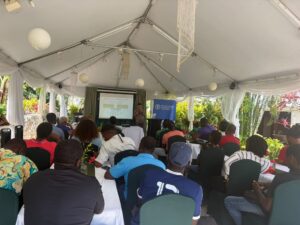
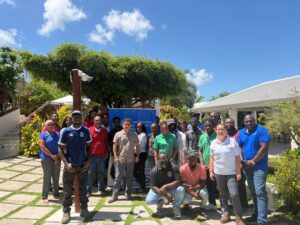 Farmers and extension officers are gaining practical knowledge to improve nutrient management, fertilizer use and overall efficiency in vegetable production through a two-day Practical Training on Nutrient Management for Vegetable Production being held at Indies Greens, Upper Renfrew, St. John’s.
The training, taking place from September 24–25, 2026, is being facilitated by the Food and Agriculture Organization of the United Nations (FAO), in collaboration with the Ministry of Agriculture, Lands, Fisheries and the Blue Economy of Antigua and Barbuda. The training is being delivered under two complementary FAO projects: Digital Solutions to Improve Horticultural Crop Management in the Caribbean (FVC/SLC/215/MUL) and Sustainable Water Management and Access for Better Production in Antigua and Barbuda (TCP/ANT/4001), with additional support from FAO regular programme funds.
The sessions combine classroom discussions with practical field-based activities, focusing on nutrient management principles, crop nutrient requirements, soluble fertilizer calculations, fertigation and the practical use of nutrient-management tools for both open-field and protected cultivation systems.
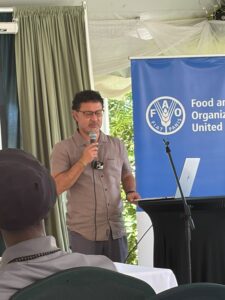
Opening the training, Ika Fergus of the Ministry of Agriculture highlighted the importance of strengthening nutrient management practices within the agricultural sector. He noted that inconsistent nutrient application, incorrect fertilizer selection and inappropriate application methods can affect soil health, crop yields and production costs.
Fergus explained that the training comes at an important time as the Ministry continues to strengthen the technical capacity of extension officers and support farmers in adopting improved practices. He encouraged participants to remain engaged, ask questions and share the knowledge gained with fellow farmers and stakeholders so that the benefits of the training can extend throughout farming communities.
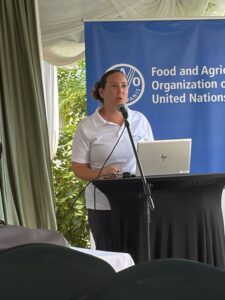
Anne Desrochers, Lead Technical Officer for FVC/SLC/215/MUL and Plant Production and Protection Specialist with the FAO Sub-Regional Office for the Caribbean, emphasized that the training was designed to be an interactive exchange rather than a traditional classroom setting.
“We want to learn from you what you’re doing right now on your farm,” Desrochers explained, noting that the discussions would allow participants and technical experts to identify opportunities to improve current practices and determine how to move forward.
She outlined how the two FAO projects complement one another by supporting farmers and extension officers in improving water, nutrient and crop management through practical tools, climate-smart approaches and strengthened technical capacity.
The digital horticulture project, which began in March 2024, includes activities focused on digital sensors, micro-agro-climate data collection, improved water and crop management, fertilizer application, pest and disease management and strengthening national advisory capacity. As part of this work, soil scanners have been provided to support the collection of soil data directly in the field. The information can then help farmers and extension officers better understand soil conditions and make informed decisions about nutrient applications.
Desrochers also highlighted the development of a digital application designed to use soil data to assist with fertilizer and nutrient calculations. Participants were introduced to the application and the tools and spreadsheets used in its development, with the practical demonstration forming part of the training.
Environmental, soil and water sensors have also been installed at demonstration sites in Antigua and Barbuda. These tools can provide information on soil and water conditions, as well as environmental factors such as temperature and humidity, particularly in protected cultivation systems.
The second project, TCP/ANT/4001, focuses more broadly on sustainable water management and access for better production in Antigua and Barbuda. Its activities include improving water management, assessing existing protected crop production systems and training farmers and extension officers in climate-smart and digital approaches to soil, nutrient, water and pest management.
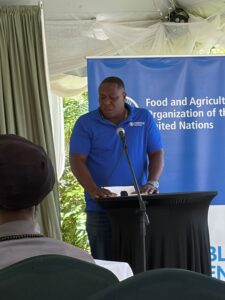
Leading the technical discussion on plant nutrition was Mr. Melvin Medina Navarro, Senior Policy Officer with the FAO Regional Office for Latin America and the Caribbean. He explained that the training was organized in response to the need for greater efficiency in fertilizer application and to support the development and use of a fertilizer-management software application.
Medina Navarro stressed that plant nutrition is only one part of successful crop production. Weed control, pest and disease management, water management, cultural practices and other factors must also be properly managed to achieve good yields.
He also highlighted the close relationship between water and nutrient uptake. Plants absorb nutrients when they are dissolved in water, making proper water management an important part of nutrient management.
Using the analogy of a “soup,” Medina Navarro explained that the nutrient solution available to plants consists of water and the necessary nutrients. These nutrients can come from different sources, including compost, manure, fertilizers and the soil itself. He also emphasized the importance of developing a healthy root system, since roots are responsible for taking up water and nutrients.
Participants were introduced to the essential nutrients required by plants, including primary, secondary and micronutrients. Medina Navarro explained that the difference between these categories is the quantity required by plants, rather than their importance. A deficiency in a micronutrient can still significantly affect plant growth.
The discussion also examined nutrient deficiency symptoms and how these can be identified in the field. Participants considered examples involving calcium, phosphorus, potassium, sulfur, iron, boron, copper and manganese. Calcium deficiency and blossom-end rot were among the examples discussed, with emphasis placed on considering soil pH when determining appropriate corrective measures.
The importance of developing a fertilizer programme based on actual crop requirements was also highlighted. Medina Navarro explained that farmers first need to know how much of each nutrient a crop requires, while soil and, where applicable, water analysis can provide information on nutrients already available.
Other factors include the type of fertilizer available, how it will be delivered and how frequently it should be applied. These decisions may involve granular fertilizers, dissolved fertilizers or application through irrigation and fertigation systems.
Nitrogen management received particular attention. Participants discussed how nitrogen deficiency can result in yellowing of leaves, while excessive nitrogen can encourage excessive vegetative growth, including thick stems and abundant leaves with reduced fruit production. Tomato plants were used to demonstrate some of the symptoms that can occur when nutrient levels are not properly managed.
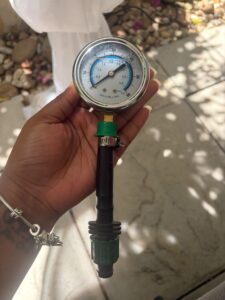
Day One also covered fertilizer formulations and nutrient content, fertilizer calculations, practical nutrient-management tools, drip irrigation and fertigation management. Participants examined the operation of drip irrigation systems, the use of Venturi injectors, fertilizer injection, filtration, flushing, maintenance and troubleshooting.
The training also provided an opportunity for participants to introduce themselves and identify the organizations, farms and institutions they represented, encouraging interaction and knowledge-sharing among those involved in agriculture.
The practical sessions are intended to help participants move beyond understanding the concepts to applying nutrient-management principles under real production conditions, supporting more efficient use of fertilizers, water and other agricultural inputs.
The training forms part of ongoing efforts by the Ministry and FAO to strengthen climate-smart horticultural production in Antigua and Barbuda and equip farmers and extension personnel with practical knowledge and digital tools to support more informed crop management decisions.