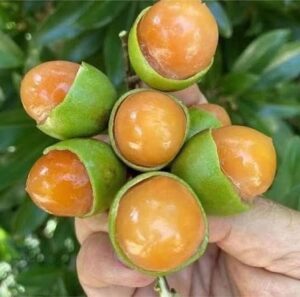
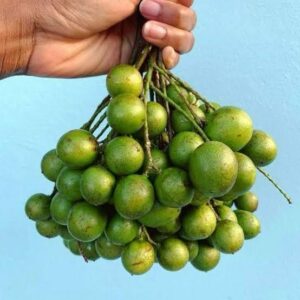
If you’re from Antigua and Barbuda, you probably know this little green fruit as Guinep
Know The Facts
One fruit, many names!
If you’re from Antigua and Barbuda, you probably know this little green fruit as Guinep. You crack open the green shell, find the soft juicy flesh inside, and enjoy that sweet, sometimes slightly tart, Caribbean flavour.
But here’s the fun part:
What we call Guinep in Antigua has a completely different name in some of our neighbouring Caribbean islands!
Let’s get to know this beloved tropical fruit.
What is Guinep?
Guinep is the fruit of the tree scientifically known as Melicoccus bijugatus. It belongs to the Sapindaceae family, also known as the soapberry family, the same broader plant family that includes fruits such as Lychee and Rambutan. The tree is native to northern South America, particularly Colombia and Venezuela, but it has become widely cultivated or naturalized throughout the Caribbean and other tropical regions.
In Antigua and Barbuda, we know it as:
❖ Guinep
But that’s only one of its many names!
One fruit, many Caribbean Names
Here’s where Guinep gets really interesting.
Country Common name
Antigua & Barbuda Guinep
Jamaica Guinep / Ginep
Trinidad & Tobago Chennet / Chennette
St. Lucia Chennet
Dominica Kenip / Quenet
Grenada Skinup
St. Kitts Skinnip
Puerto Rico Quenepa
Dominican Republic Limoncillo / Quenepa
Cuba Mamoncillo
Haiti Quenepe
French Caribbean islands Quenette / Kenepier
Virgin Islands Genip / Ginep
Barbados Ackee
These names are documented in botanical and Caribbean plant references, although names can vary even within the same island or region.
What does the Guinep tree look like?
Guinep grows on a large, long-lived tree with a dense, rounded canopy. The tree can reach considerable heights — some sources report mature trees reaching around 20 metres or more, depending on growing conditions. Its leaves are made up of pairs of smooth, oval leaflets, giving the foliage a distinctive appearance. And when the tree produces fruit, it can look like bunches of little green grapes! The fruits develop in clusters, making a fruiting tree particularly easy to recognize.
What does a Guinep look like inside?
The outside is usually:
● Green
● Firm
● thin but tough
Break open the shell and you’ll find:
● yellowish, peach-coloured or translucent flesh
● a large seed
● a sweet or slightly tart flavour
The edible flesh is attached closely to the seed, which is why people traditionally suck the juicy pulp from around the seed.
And here’s a little warning worth remembering:
 watch the seed!
The fruit has a large seed, so care should be taken when eating it, particularly with young children.
Here’s a surprising fact!
Guinep isn’t actually a citrus fruit! Despite another common name being “Spanish lime,” Guinep is not a lime. It belongs to the Sapindaceae family.
Its scientific name is:
Melicoccus bijugatus Jacq.
So don’t let the name “Spanish lime” fool you!
Where did Guinep come from?
The species is considered native to northern South America, particularly Colombia and Venezuela.
From there, it spread throughout tropical regions and became established across much of the Caribbean.
The Smithsonian’s West Indies botanical records document Melicoccus bijugatus in numerous Caribbean locations, including Antigua, Barbuda, Barbados, Dominica, Jamaica, Cuba, Puerto Rico, the Virgin Islands and several of the Lesser Antilles.
More than just a snack!
Guinep is primarily valued for its edible fruit, but the tree has other uses as well.
Research and botanical resources document uses associated with:
● Food
● animal feed
● timber and wood
● traditional uses
● shade and landscaping
FAO-linked resources also document the use of Guinep fruit and by-products in animal feed.
Why is Guinep important to agriculture?
Guinep may seem like a simple fruit we enjoy during the summer, but it has a place in Caribbean agriculture and food culture.
1. it is a fruit crop
Guinep trees produce an edible fruit that can be consumed fresh. Growing and maintaining fruit trees contributes to crop diversity and gives farmers additional options for producing food.
2. it contributes to food security
Having a variety of locally grown fruits helps diversify the foods available to communities. Guinep is one of the many tropical fruits that can contribute to the Caribbean’s agricultural food supply.
3. it can provide income for Colesome Farmers Market
Guinep can be sold fresh when the fruit is in season, providing an opportunity for farmers and small-scale vendors to earn income from a crop that is well known and enjoyed throughout the region.
4. it adds to agricultural diversity
Growing different types of fruit trees helps maintain agricultural biodiversity. Guinep is part of the diverse collection of tropical fruit crops found throughout the Caribbean.
5. the trees have additional uses
Guinep trees are long-lived and provide shade and other environmental benefits. The wood has also been used for various purposes, while the tree itself can form part of home gardens and agricultural landscapes.
6. it is part of our Caribbean agricultural heritage
Perhaps one of the most interesting things about guinep is how deeply connected it is to Caribbean culture.
Sources: Food and Agriculture Organization of the United Nations (FAO); University of Florida Institute of Food and Agricultural Sciences (UF/IFAS); FAO AGRIS; and the Crop Diversity/Musa Germplasm Information System.