Coconut!The Tree of Life.
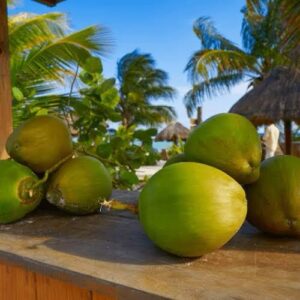 Coconut
The Tree of Life.
What if one tree could provide food, drink, shade, materials, income and even help protect our coastline?
Meet the coconut, one of the most useful and familiar plants in tropical agriculture!
Here in Antigua and Barbuda, the coconut palm (Cocos nucifera) is much more than a beautiful tree swaying in the breeze. It is part of our landscape, our food culture, our agricultural heritage and our everyday island life.
From water to meat, there is more to the coconut!
When you crack open a fresh coconut, you get much more than a refreshing drink.
❖ Coconut water is naturally refreshing and contains electrolytes.
❖ Coconut meat can be eaten fresh, grated or used in a variety of traditional dishes and desserts.
❖ Coconut milk is widely used in cooking and adds flavour and richness to many Caribbean meals.
❖ Coconut oil can be used in cooking and in a variety of personal-care products.
❖ And the coconut palm itself can provide materials that have traditionally been used for crafts and other purposes.
This versatility is one reason the coconut has earned the nickname “The Tree of Life.”
A Coconut connection to Antigua.
Coconuts have long been part of Antigua and Barbuda’s agricultural landscape. Coconut palms can be found along coastlines, around farms, in villages and in home gardens.
The Ministry of Agriculture’s Forestry Unit continues to propagate and distribute coconut and other fruit trees through its nursery activities.
But Antigua’s coconut story has not always been an easy one.
Rebuilding our Coconuts.
In 2016, Antigua and Barbuda experienced a devastating outbreak of Lethal Yellowing, which destroyed almost all of the country’s native coconut palms.
In response, the Ministry of Agriculture’s Forestry Unit began efforts to rebuild the country’s coconut population. The Ministry invested in coconut planting material, with support from the Caribbean Agricultural Research and Development Institute (CARDI).
By 2022, the Ministry launched the Coconut Rehabilitation Programme, distributing seedlings to farmers and other participants to help restore coconut production across the country. More than 5,000 seedlings had been distributed by 2024.
This is more than planting trees, it is rebuilding an agricultural resource for future generations.
Did you know Coconuts can help our coastline?
Coconut palms are not only valuable for their fruit.
Their presence along coastal areas contributes to the natural landscape and can provide shade and habitat. Their roots also help hold soil in place, making coconut palms an important part of the wider coastal environment.
And here’s a fascinating fact:
● A coconut can float!
This ability has helped coconuts spread naturally across tropical coastlines and islands over time.
From Farm to Business.
The coconut also represents an opportunity for agro-processing and entrepreneurship.
Instead of selling only the fresh fruit, locally grown coconuts can become value-added products such as:
● Coconut oil
● Coconut milk
● Coconut flakes
● Coconut-based sweets and pastries
● Beverages
● Soaps and personal-care products
● Other processed food products
This creates opportunities to turn a locally grown agricultural product into products with greater economic value.
The Ministry has also supported coconut production at agricultural stations, including a coconut plot at the Greencastle Agricultural Station, where irrigation was installed to support production and explore opportunities within the coconut value chain.
Why should we care about coconuts?
Because supporting coconut production means supporting more than a single crop.
It can contribute to:
● Agricultural diversification
● Food and nutrition
● Farmers’ livelihoods
● Agro-processing opportunities
● Environmental sustainability
● Agricultural resilience and food security
And perhaps most importantly, every coconut tree planted today can become part of the agricultural landscape enjoyed by future generations.
So, the next time you see a coconut tree…
Don’t just see a palm tree.
See food.
See farmers.
See business opportunities.
See our agricultural heritage.
See the potential for a stronger and more resilient coconut sector in Antigua and Barbuda.
From the coconut water we enjoy to the products we can create, the humble coconut has a lot to offer.
Let’s continue to plant, protect, produce and make the most of what grows right here at home.
Sources: Ministry of Agriculture, Lands, Fisheries and the Blue Economy, Antigua and Barbuda; Government of Antigua and Barbuda; Caribbean Agricultural Research and Development Institute (CARDI); Food and Agriculture Organization of the United Nations (FAO).