Antigua’s Black Pineapple
 Antigua’s Black Pineapple
Sweet. Rare. Antiguan.
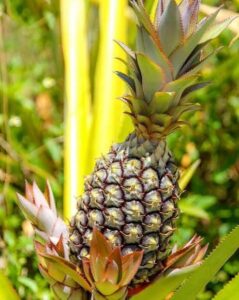
When you hear the words “Black Pineapple,” you might imagine a pineapple with black flesh or black skin. But Antigua’s famous Black Pineapple is not actually black! So, what makes this fruit so special?
A National Treasure.
The Antigua Black Pineapple (Ananas comosus) is the national fruit of Antigua and Barbuda and is deeply connected to the island’s agricultural heritage. Historical records from the Government of Antigua and Barbuda note that the pineapple was introduced by Arawakan-speaking people and was traditionally used not only as food, but also for making twine and cloth and for medicinal purposes.
Today, the Black Pineapple remains one of Antigua’s most recognizable agricultural products.
Why “Black”?
Despite its name, the fruit does not turn black when ripe. It is known for its distinctive appearance and, when mature, develops a rich golden colour. The name “Black Pineapple” is part of the variety’s traditional identity and heritage.
Famous for its Sweetness.
What really sets the Antigua Black Pineapple apart is its exceptionally sweet flavour and relatively low acidity compared with many other pineapple varieties. It has long been recognized as a highly valued local fruit, with strong demand on the domestic market.
That sweetness makes it a favourite for eating fresh, but its potential doesn’t stop there. Pineapple can also be used to make products such as juice, jams, preserves and desserts, creating opportunities to add value to locally grown produce.
More than a Fruit, A symbol of Antiguan Agriculture.
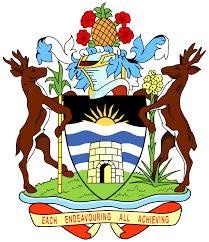
The importance of the Black Pineapple is even reflected in our national Coat of Arms, where the pineapple is prominently featured as a symbol of Antigua’s agricultural heritage.
For generations, this unique crop has been associated particularly with the southern and southwestern areas of Antigua, becoming part of the island’s agricultural identity.
Bringing back the Black Sweetness.
Like many traditional crops, Black Pineapple production has faced challenges, including limited access to quality planting material and difficulties maintaining production on a larger scale. FAO previously identified the availability of planting material as a major constraint to production.
But there is exciting work underway!
The Ministry of Agriculture, Lands, Fisheries and the Blue Economy, in collaboration with partners including IICA and CARDI, has been working to rehabilitate and strengthen Antigua Black Pineapple production.
Through tissue-culture propagation, thousands of pineapple plantlets have been introduced as part of efforts to increase the availability of healthy planting material and expand production. In February 2025, 5,000 tissue-culture plants were transplanted at the Cades Bay Station, with additional plantlets planned for subsequent planting.
And the work continues. In September 2026, the Ministry reported that it was awaiting another 27,000 pineapple plants to support the expansion of pineapple cultivation across Antigua and Barbuda.
Could Antigua’s Black Pineapple go even further?
Absolutely!
The uniqueness and reputation of the Antigua Black Pineapple have also led to discussions surrounding Geographical Indication (GI) recognition. FAO and IICA have worked with local stakeholders to explore the potential of GI status, which could help protect the product’s reputation while creating opportunities for stronger market access and greater value for producers.
So, the next time you see an Antigua Black Pineapple…
Remember that you are looking at more than a delicious tropical fruit.
You are looking at a piece of Antiguan agricultural heritage, a crop represented on our national Coat of Arms, and a product with the potential to contribute to the future of local agriculture.
From our fields to our tables, let’s grow, support and celebrate what is uniquely Antiguan.
Sources: Ministry of Agriculture, Lands, Fisheries and the Blue Economy; Government Information Service (GIS); Food and Agriculture Organization of the United Nations (FAO); Caribbean Agricultural Research and Development Institute (CARDI).