Aeroponics and Permaculture
 Know The Facts
Aeroponics and Permaculture
What if plants could grow with their roots hanging in the air? And what if a farm could be designed to work more like nature?
Sounds futuristic, but both are already part of modern agricultural thinking!
Today, we’re looking at Aeroponics and Permaculture.
What is Aeroponics?
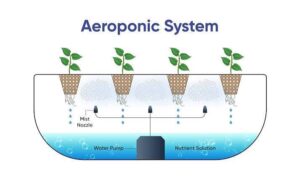
Aeroponics is a soilless method of growing plants in which the plant roots are suspended in air and supplied with water and nutrients through a fine mist.
Instead of roots being planted in soil or sitting in a nutrient solution, they are exposed to air while a nutrient-rich mist is delivered directly to them.
Think of it as:
AIR + MIST + NUTRIENTS + PLANT = AEROPONICS
The roots receive direct access to water, nutrients and oxygen.
This makes aeroponics a type of controlled-environment, soilless production system, and it can be particularly interesting where space and water efficiency are important considerations.
Here’s the interesting part…
In an aeroponic system, you can actually see the plant’s roots hanging in the air!


Plant
Roots suspended in air


Fine nutrient mist
It may look like something from the future, but researchers have been using aeroponic systems for decades. USDA researchers, for example, use aeroponics to study plant roots because the roots can be accessed without digging them out of soil.
What is Permaculture?
Now let’s switch gears.
Permaculture is not a particular machine, growing system or method of delivering nutrients to plants.
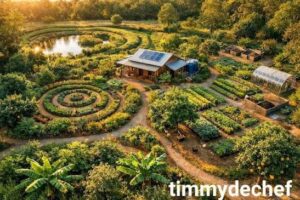
It is a design approach that seeks to create productive agricultural systems inspired by the patterns, diversity and resilience found in natural ecosystems.
The idea is to ask:
How does nature work?
And then:
How can we design our farms, gardens and communities to work more like natural ecosystems?
Permaculture can involve the thoughtful integration of:
Plants Trees
Trees Pollinators
 Animals Water
 Soil
Soil Energy
 People
Rather than treating every part of a farm as completely separate, permaculture looks at how the different parts can work together.
Where did Permaculture come from?
The modern permaculture movement emerged in Australia during the 1970s, associated particularly with Bill Mollison and David Holmgren.
The concept has since developed beyond simply growing food. It can encompass the design of gardens, farms, landscapes, homes and communities with greater attention to ecological relationships and resource use.
A simple way to remember its philosophy is:
● Care for the Earth
● Care for People
● Use resources responsibly and share fairly
So what’s the big difference ?
Here’s the part to remember:
Aeroponics Permaculture
A method of growing plants A design approach for sustainable systems
Plants grow without soil May use soil and traditional growing methods
Plants grow without soil Works with natural ecosystems and relationships
Roots are suspended in air Focuses on designing systems that make use of natural processes
Nutrients and water are delivered as a mist Often emphasizes diversity, integration and resilience
Aeroponics = How you grow the plant.
Permaculture = How you design the whole system.
Can they work together?
Absolutely!
Aeroponics and permaculture don’t have to be viewed as opposites.
Permaculture is about designing systems and relationships, while aeroponics is a particular production technology.
A farmer or grower could therefore use principles of sustainable system design while also incorporating modern technologies where appropriate.
The goal is not simply to choose “old” or “new” agriculture.
It is about asking:
What approach makes sense for the environment, the resources available and the needs of the community?
Why does this matter for Antigua and Barbuda?
As an island nation, Antigua and Barbuda faces agricultural considerations including limited land and water resources, climate variability and the need to strengthen local food production.
This makes it important to understand the range of agricultural approaches available from traditional farming and agroforestry to controlled-environment technologies such as aeroponics and integrated approaches inspired by ecological systems.
FAO describes sustainable agriculture as involving the responsible management and conservation of natural resources while meeting human needs across generations.
Innovative technologies and ecological approaches can therefore be part of the wider conversation about food security, climate resilience and sustainable agriculture.
Information sources: Food and Agriculture Organization of the United Nations (FAO), United States Department of Agriculture (USDA), and university agricultural extension resources.