Practical Training on Nutrient Management for Vegetable Production Continues with Field-Based Soil Testing and Fertilizer Demonstrations by Shenequa Williams
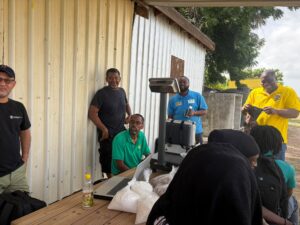
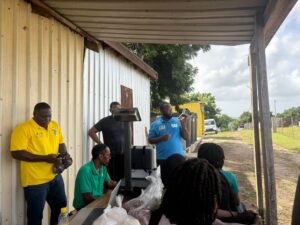
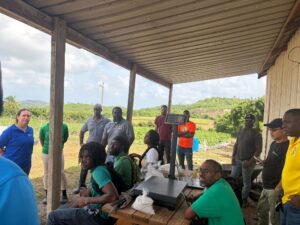
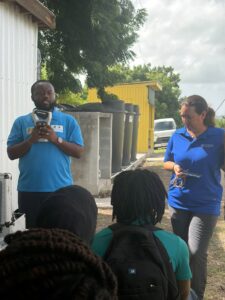
The practical training on Nutrient Management for Vegetable Production continued on Friday, 25 September 2026, with a hands-on field exercise at MSB Farm. The day’s activities focused on soil testing, fertilizer preparation, fertigation and the practical application of nutrient management techniques for vegetable production.
The session was led by Mr. Adrian Bowen/Extension Officer within the Ministry of Agriculture, Lands, Fisheries and the Blue Economy, with technical support from the Food and Agriculture Organization of the United Nations (FAO).
Participants were introduced to the practical preparation of fertilizers, including the weighing and measuring of fertilizers according to calculated requirements and the preparation and mixing of fertilizer solutions. The session also examined important considerations when preparing fertilizers for application through fertigation systems.
A major component of the day was the practical field exercise, which allowed participants to apply the knowledge gained directly on the farm. Participants visited both open-field and protected cultivation systems, where they observed the operation of a Venturi injector and participated in the practical application of prepared fertilizers through a fertigation system.
Participants received practical guidance on proper soil sampling and the importance of collecting representative samples. It was explained that soil samples should be collected from different points across a field rather than from a single location, particularly where there may be variations in soil conditions.
The appropriate sampling approach can also depend on the crop being planted, the size and layout of the production area, and the irrigation system being used. Where different areas of a field have visibly different soil conditions or are managed through separate irrigation zones, samples may need to be collected and assessed separately.
Participants were also advised that the depth of soil sampling can vary depending on the crop being planted. Different crops, including root crops and leafy vegetables, may require samples to be collected at different depths.
Once collected, the soil samples were mixed thoroughly, with stones, debris and other unwanted material removed before testing. The practical demonstration highlighted that proper sample preparation is important for obtaining reliable results.
A soil scanner was demonstrated as part of the practical exercise. Participants were shown how the device could be calibrated and used to analyse soil samples. The process required the soil to make proper contact with the centre of the scanner’s sensor, with multiple scans taken to ensure that the sample could be accurately assessed.
The technology provided information on several soil properties, including nutrient levels, organic matter, organic carbon, nitrogen, phosphorus, potassium, magnesium and other indicators of soil condition.
One of the samples tested during the exercise produced results showing adequate nitrogen, high potassium and magnesium levels, and adequate organic carbon. The results also provided information on the soil’s clay content and cation exchange capacity, which help indicate the soil’s ability to retain and supply nutrients.
Participants were also shown that the raw results from the scanner must be properly interpreted before fertilizer recommendations can be made. This includes converting measurements into the appropriate units and entering the information into the relevant software or programme.
The practical exercise demonstrated how soil testing can be connected to fertilizer planning. Rather than applying nutrients based solely on general recommendations, soil test results can be used to determine the nutrient requirements of a particular crop and production area.
Participants discussed how nutrient requirements may differ between crops. A nutrient level that may be suitable for one crop may not necessarily be appropriate for another. For this reason, the crop being grown must be considered when interpreting soil test results and developing fertilizer recommendations.
The training further demonstrated how the results can be entered into a programme to determine the respective nutrient requirements and guide the quantities of fertilizer needed for application through an irrigation system.
The field exercise also provided an opportunity for discussion on the possible use of soil testing services for farmers. Participants explored how farmers could potentially receive guidance on collecting and preparing samples before bringing them for testing, helping to ensure that the samples submitted are suitable for analysis.
The day concluded with a review of the field exercise, questions and discussions among participants. The practical demonstrations reinforced the importance of accurate soil sampling, reliable testing, correct fertilizer preparation and proper fertigation management in supporting more informed nutrient management for vegetable production.