THE ALLURE OF SOIL
THE ALLURE OF SOIL
Building the Restoration Generation
A synthesis report on soil awareness, science and youth-led restoration
Executive Summary
Soil is the least visible and most undervalued infrastructure on which food systems, water security, climate resilience, biodiversity and human livelihoods depend.
This report brings together the case made across two connected bodies of work: The Allure of Soil campaign, which reframes soil as an object of beauty, culture and story rather than a purely technical concern, and a body of soil-science and youth-education material that grounds that story in the biology of living soil and in a generational plan for restoration.
Together they argue for the same conclusion from two directions: soil will not be restored by science alone, and it will not be restored by sentiment alone. It requires both — and it requires everyone, from farmers and scientists to governments, financiers, educators and consumers, to treat soil as shared, common ground.
Who We Are: The Allure of Soil
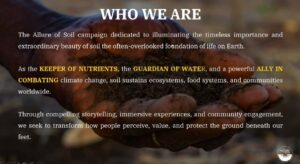
The Allure of Soil is a campaign dedicated to illuminating the timeless importance and extraordinary beauty of soil — the often-overlooked foundation of life on Earth. As the keeper of nutrients, the guardian of water, and a powerful ally in combating climate change, soil sustains ecosystems, food systems and communities worldwide.
Through compelling storytelling, immersive experiences and community engagement, the campaign seeks to transform how people perceive, value and protect the ground beneath their feet.
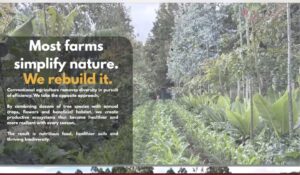
Its founding premise is captured in a simple but pointed contrast: most farms simplify nature in pursuit of efficiency, stripping out diversity; regenerative approaches instead rebuild it — combining dozens of tree species with annual crops, flowers and beneficial habitat to create productive ecosystems that grow healthier and more resilient with every season. The result is nutritious food, healthier soils and thriving biodiversity, and it is offered as proof that restoration is not a sacrifice of productivity but a route back to its natural form.
The Soil Awareness Gap
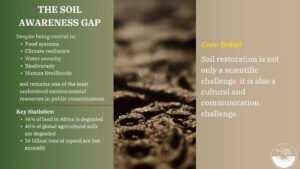
Despite sitting at the centre of food systems, climate resilience, water security, biodiversity and human livelihoods, soil remains one of the least understood environmental resources in public consciousness. The scale of the problem is stark: 46% of land in Africa is degraded, 40% of global agricultural soils are degraded, and 36 billion tons of topsoil are lost annually. The core belief driving this work is that soil restoration is not only a scientific challenge it is also a cultural and communication challenge. Closing the awareness gap is treated as a precondition for closing the restoration gap.
Understanding Soil as a Living System
The scientific foundation begins with a correction: soil is not dirt. It is a living system — infrastructure for life — and food, water, climate, biodiversity and livelihoods all depend on it. Soil is not simply the medium in which plants grow; it is an ecosystem that makes growth possible.
A single handful of soil is itself an ecosystem, spanning macro-organisms to microorganisms, each performing different functions within the soil food web of plants, animals, fungi, bacteria, arthropods, nematodes and decomposers. In formula terms, soil is Minerals + Organic Matter + Water + Air + Roots + Life.
That living function underpins soil health across five interlinked dimensions: food (productivity, nutrition, food security), water (infiltration, storage, clean water), climate (carbon, drought resilience, flood buffering), biodiversity (habitat, microbial life, ecosystem function) and livelihoods (income, resilience). The guiding principle is direct: change the soil, and you change the system.
When Soil Degrades, Everything Pays
Soil degradation is not just a farmer’s problem, even though the farmer sees it first. It moves through a predictable chain: loss of organic matter, biological activity and structure leads to poor infiltration, erosion and nutrient loss; that in turn produces lower productivity, higher input dependence and greater production risk; and the final cost is paid across food, water, climate, biodiversity and livelihoods alike. The farmer sees the problem first, but society eventually pays the bill.
The Anthropology of Living Soil
“The anthropology of living soil doesn’t ignite — it attracts. It attracts people not through alarm, but through the pull of belonging: soil as culture, memory and relationship, something communities move toward and act on because they recognise themselves in it.”
— Magreth
This framing, offered by Magreth, is the cultural counterpart to the science above. It reframes the entry point for engagement: rather than trying to shock or alarm people into caring about soil, the anthropological view treats living soil as something with its own pull — a set of relationships between people, land and memory that draws communities toward participation rather than pushing them into it through fear. Attraction, in this sense, is not a marketing tactic; it is the recognition that people act most durably on what they feel connected to, not merely on what they are warned about.
This is precisely the logic behind The Allure of Soil’s engagement pathway — soil stories, webinars, farm tours and workshops, and digital media designed to build emotional connection first, and stewardship as its natural extension. Living soils, understood in this anthropological sense, are not simply a technical substrate to be managed; they are living systems of meaning that communities have every reason to be drawn back toward.
Soil Health: What Are We Really Trying to Restore?
Restoring soil health is, at bottom, about function. It rests on three interlocking dimensions — physical (structure, aggregation, infiltration, water holding), chemical (pH, nutrients, organic carbon, nutrient balance) and biological (microbes, fungi, earthworms, roots, nutrient cycling) — that together determine whether soil can infiltrate and store water, cycle nutrients, support roots, resist erosion, and sustain productivity while maintaining its ecological functions. Healthy soil, on this definition, is simply soil that can continue to perform its essential functions.
The Good News: Soil Can Change
Degradation is not necessarily a point of no return. Soil has a remarkable capacity to recover when the conditions for life are restored: bare soil can become covered soil, disturbance can give way to living soil, single-crop systems can become diverse ones, nutrient loss can be reversed into nutrient cycling, runoff can become infiltration, and declining function can be rebuilt into regenerative capacity. The fundamental shift required is not technological; it is conceptual — moving from treating soil as a resource to treating it as a living system, from extraction to regeneration, from short-term output to long-term capacity, from inputs alone to biology plus management plus inputs, from farm-level thinking to landscape thinking, and from soil as a farmer’s responsibility to soil as a shared responsibility.
From Classroom Literacy to Youth-Led Restoration
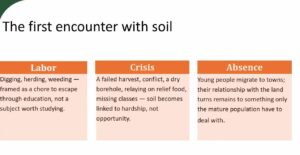
If soil science explains what must change and the anthropology of living soil explains why people will choose to act, the youth-education strand explains where the next generation of actors is being built. Many young people’s first encounter with soil is not inviting. It arrives through labour — digging, herding, weeding — framed as a chore to escape through education rather than a subject worth studying. It arrives through crisis — a failed harvest, conflict, a dry borehole, relying on relief food, missing classes — so that soil becomes linked to hardship rather than opportunity. And for many, it arrives through absence: young people migrate to towns, and their relationship with the land remains something only the mature population has to deal with.
The response is to deliberately move students from classroom literacy to youth-led restoration, using learning approaches that make soil tangible and generative rather than punitive: school tree nurseries and woodlots where students propagate indigenous, drought-resistant species and track survival rates; land and conservation restoration clubs that adopt and monitor a specific eroded gully or overgrazed plot across multiple school terms; elder-mentor partnerships that treat knowledge-holders as standing co-teachers rather than one-off guest speakers; and field partnerships with research institutions, including structured school visits to demonstration sites and local farms.
In action, this becomes scholar-led micro-projects that connect schools and communities, mentorship that equips youth to tackle local environmental issues, and resources that make conservation learning practical. School projects turn learning into action, teacher and student outreach builds early environmental stewardship, and early conservation exposure shapes future study and career choices — converting soil from a symbol of hardship into a subject of agency.
Soil as a National Security Asset
“Soil should be treated as a national security asset — managed not by farmers alone, but by all actors: government, finance, business, research and communities together.”
— Boaz
Boaz’s framing pushes the argument from the cultural and educational register into the register of governance and strategy. Treating soil as a national security asset means recognising that its degradation carries the same order of consequence as failures in energy, water or food supply — it threatens productivity, drives displacement, deepens dependence on imports and relief, and compounds climate and conflict risk.
Framed this way, soil cannot be left as the sole responsibility of the individual farmer who happens to see the damage first; it has to be actively managed, protected and invested in by the full range of actors who depend on it governments setting policy and protection, finance directing capital toward regenerative practice, businesses embedding soil health into supply chains, scientists and extension services generating and transmitting knowledge, and communities and consumers exercising demand and stewardship.
This is the same conclusion reached from the soil-science material’s own closing question: soil changes everything, so the real question is no longer whether soil matters, but who will change how we treat it. The answer offered is that the Restoration Generation is all of us — farmers, scientists, extension and educators, businesses, finance, governments, and communities and consumers, arranged around soil as a shared centre rather than a private burden.
Our Approach: Connecting Science, Storytelling and Community
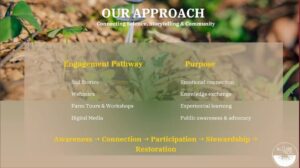
Operationally, this convergence of science, culture and governance is pursued through a single engagement pathway: soil stories, webinars, farm tours and workshops, and digital media, chosen to build emotional connection, knowledge exchange, experiential learning, and public awareness and advocacy in turn. The intended progression runs from awareness to connection, to participation, to stewardship, and finally to restoration — treating each stage as a deliberate step rather than assuming that information alone will produce behaviour change.
Opportunities for Collaboration
• Storytelling collaborations — human-centred storytelling around restoration, resilience and regenerative agriculture, of the kind Magreth’s anthropological framing calls for.
• Knowledge exchange — collaborative webinars, dialogues, workshops and learning networks connecting communities and practitioners across the science, education and policy strands described above.
• Cross-sector partnership — extending Boaz’s national-security framing into practice by bringing government, finance, business, research and community actors into joint stewardship of soil as shared infrastructure.
• School and youth partnerships — supporting tree nurseries, conservation clubs, elder-mentor programmes and field visits that turn the youth-education pathway into standing local practice.
Conclusion
Read together, these strands make one argument in three voices. The soil science establishes that soil is a living, functional system whose degradation is reversible when the conditions for life are restored. Magreth’s anthropology of living soil explains why people will move toward that restoration voluntarily — attraction and belonging succeed where alarm alone does not. And Boaz’s call to treat soil as a national security asset insists that this restoration cannot be left to individual farmers or isolated projects; it must be managed as shared infrastructure by every actor with a stake in it. The Restoration Generation, on this view, is not a slogan but a design requirement: it is built in classrooms and conservation clubs, told through soil stories and community storytelling, and finally secured through policy and investment that treats living soil as the common ground it is.